Book Review of Samuel N. Dorf, Performing Antiquity: Ancient Greek Music and Dance from Paris to Delphi, 1890-1930 (New York: Oxford University Press, 2018)
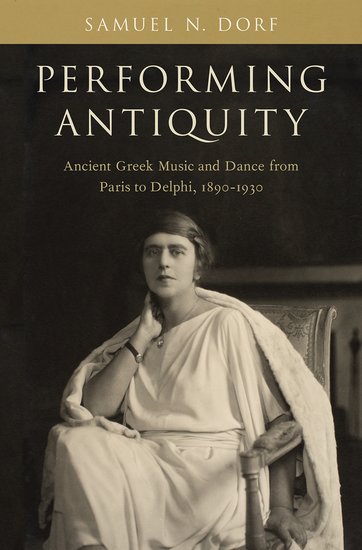
Delphi, 1890-1930 (New York: Oxford University Press, 2018). Link to the Oxford
University Press website.
Performance studies is unsettled, open, discursive, and multiple in its methods, themes, objects of study, and persons. It is a field without fences. It is “inter” […]. Being “inter” is exploring the liminal–participating
Richard Schechner quoted in Dorf 2018, 105
in an ongoing workshop.
In his book Performing Antiquity: Ancient Greek Music and Dance from Paris to Delphi, 1890-1930, Samuel Dorf argues that performance studies has a great deal to offer musicology in terms of understanding musical performance. Performance studies enables us to shift attention away from the problematic notion of historical authenticity (performing musical works as they actually were) toward the motivations, fantasies, and desires underlying performance practices. Drawing on Diana Taylor’s consideration of the historical aspects of performance with regard to the archive and repertoire, Dorf makes a distinction between performances “primarily informed by the archive” (i.e. by artifacts found in the archive) and performances “drawn primarily from the repertoire” (the embodied knowledge and practice of actually living performers). Ideally, performances of the past are based on both the archive and repertoire, though not necessarily. Performing Antiquity also identifies some “unsuccessful” performances of the past–for example, Maurice Emmanuel’s opera Salamine, which remained too dutiful to Emmaneul’s archival research and not sufficiently attuned to existing performance practices at the Paris Opéra. Moreover, Dorf refers to Rebecca Schneider’s study of Civil War re-enactors, who “engage in this activity as a way of accessing what they feel the documentary evidence upon which they rely misses–that is, live experience” (quoted in Dorf 2018, 10). While “reperformances” are guided by archival materials, re-enactments seek to
convey the live experience that documentary evidence often lacks.This leads
Dorf to also consider the high stakes of historical performance–how the use
and abuse of history may cause harm to others.
Listen to a recording of Gabriel Faure’s arrangement of a second-century BCE hymn dedicated to Apollo. The working relationship between archaeologist and music scholar Théodore Reinach and Fauré is one of the many collaborations between scholars and performers discussed in Dorf’s Performing Antiquity. Read more about this “Hymn to Apollo” on the RIPM website here.
Performing Antiquity investigates the collaboration between scholars
(musicologists, archeologists) and performers of ancient Greek music and
dance in Paris in the 1890s and early decades of the twentieth century, with
an additional chapter on the first modern Delphic Festival in Greece in 1927.
Dorf’s main claim is that performance was a key feature of late nineteenth-century scholarship on antiquity, antiquity referring to “a modern imagined
Greek past” (7). These “performances” of antiquity depended on reciprocity:
“the performers gain[ed] new insight into their craft while learning new
techniques or repertoire, and the scholars gain[ed] an opportunity to bring
theory into experimental practice; that is, they [had] a chance to see/hear/experience what they [had] studied and imagined” (2). For example,
archeologist and music scholar Théodore Reinach sought out the composer
Gabriel Fauré to realize a modern accompaniment of an ancient Greek hymn
recently discovered in Delphi.
It is particularly effective how Performing Antiquity highlights the role of
technology, especially of photography, in the scholarship and performance of
antiquity in the late nineteenth century. In the early days of musicology in France, musicologists like Pierre Aubry or the Benedictines at Solesmes relied on photography to document musical notation. Similarly, archaeologists used photographs to stage their archaeological findings, and performers depended on photography to document past performances. Yet, as Dorf points out, photographs are never simply empirical tools of documentation, nor are they neutral. He writes: “photographs are simultaneously scientific tools and works of art. Photography makes visible […] imagination and fantasy” (14). Like many of the other performance strategies described in the book, photography was a means of visualizing a desired fantasy of the past.
Each chapter in the book features a different case study involving the
collaboration between scholars and performers of antiquity. Chapter 2 details
the working relationship of archaeologist and music scholar Théodore
Reinach with Gabriel Fauré. After discovering a second-century BCE hymn
dedicated to Apollo in Delphi, Reinach asked Fauré to compose a modern
instrumental accompaniment to the original melody. Chapter 3 describes the
pseudo-Greek musical and dance performance that occurred in the Parisian
home of Natalie Clifford Barney in the early 1900s. Chapter 4 examines a 1929 production of Maurice Emmanuel’s opera Salamine, with a libretto by
Théodore Reinach and choreography by Nicola Guerra based on Aeschylus’s
The Persians. Chapter 5 investigates the re-enactment of ancient Greek rites at the first modern Delphic Festival in 1927, founded by dancer Eva Palmer
Sikelianos and her husband, the poet Angehlos Sikelianos.
The concluding chapter offers a creative response to the calls by Suzanne Cusick and William Cheng for a reparative musicology–that is, a musicology
“that accepts all kinds of scholarship (and performance), that can be personal, intimate, and even political, but also does some of the work of
mending, repairing, and reconciling” (4). Reparative musicology moves in
the opposite direction of a “paranoid mode of reading,” which values the
uncovering of hidden meanings that readers are supposedly not able to find for themselves. Paranoid reading sets up a power hierarchy between the
scholar and reader. In contrast, the reparative mode of reading seeks new
contexts “for meaning to flourish that are not necessarily predicated on
authenticity or truth but rather desire, play, and, yes, love” (154). By focusing
less on who “got it right” and more on the motivations and desires underlying
historical performances, Dorf effectively demonstrates such a reparative
musicology. However, my only criticism of this book is that the discussion of
a reparative musicology focuses too narrowly on the discipline and may distract readers from the book’s broader appeal.
A second aspect that I found particularly effective about this book was Dorf’s
consideration of archival work as ethnographic (“autoethnographic”). Dorf
stresses how archival research is more than passive observation: “the
archival experiences are critical components of the performance of writing and thinking and of living this project. As a scholar in an archive I participate
in the stories I tell” (17, my emphasis). For example, by taking photos on a
smartphone, Dorf participates in the stories he tells. Performing Antiquity is
filled with lively and engaging observations about archival experiences and
research trips that make it immensely enjoyable and insightful to read. Dorf’s
autoethnographic mode of writing is also related to the types of primary sources that he consults. In addition to more traditional sources like musical
scores, librettos, and films, he also refers to fragmentary evidence scattered
across private collections, including photographs, diaries, letters, and “anecdotes told thirdhand” (18).
In conclusion, Performing Antiquity leaves the reader with a much greater
knowledge of and appreciation for the different ways that scholars and
performers imagined the ancient Greek past during the late nineteenth and
early twentieth century. The book’s significance extends far beyond the
consideration of Greek antiquity. It urges readers to examine the ways that
they perform their own research, desires, and fantasies–no matter what the
time period is. Furthermore, Performing Antiquity encourages scholars to
engage in performance and collaborate with fellow scholars and performers,
but it also serves as a cautionary tale for how these relationships may cross
boundaries and do harm–an example being the relationship between
archaeologist and art historian Salamon Reinach, writer and patron Natalie
Clifford Barney, and the dancers Régina Badet and Liane de Pougy. Though
intended primarily for musicologists and dance scholars, Performing
Antiquity appeals to a much broader audience of readers in the humanities
and sciences.
 Alexander K. Rothe, Ph.D.
Leave a comment